



For research use only
| Cat No. | ABC-TC1314 |
| Product Type | Human Leukemia Cell Lines |
| Species | Human |
| Growth Conditions | 37 ℃, 5% CO2 |
| Source Organ | Peripheral Blood |
| Disease | Acute Monocytic Leukemia |
| Product Code | Nomo-1; NOMO1 |
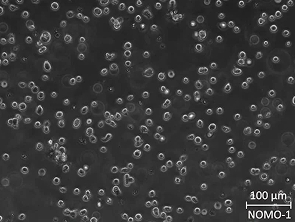
NOMO-1 human acute monocytic leukemia cells differentiate to macrophage-like cells on TPA treatment, secrete IL-1α/β and tissue factors, cultured in RPMI.
NOMO-1 is a human leukemia cell line established from the peripheral blood of a female patient with acute monocytic leukemia (AML), FAB M5a. These cells display typical myeloblast morphology with large, irregular nuclei and scant cytoplasm. NOMO-1 cell lines express myeloid markers including CD13, CD33, and CD34, confirming their immature myeloid lineage. Cytogenetic studies reveal a near-triploid karyotype with characteristic chromosomal abnormalities frequently observed in AML. Molecular profiling identifies mutations in genes such as FLT3-ITD and NPM1, common drivers in AML pathogenesis. These cells exhibit a promonocytic characteristics and can differentiate into macrophage-like cells by 12-o-tetradecanoyl phorbol-13-acetate (TPA) treatment. The cells show increased levels of fibronectin and the secretion of Interleukin-1 (IL-1) α and IL-1 β after TPA stimulation. NOMO-1 cells exhibit tumorigenic potential in immunocompromised mouse models, making them a valuable tool for studying AML biology, drug resistance mechanisms, and testing novel therapies.
| Product Code | Nomo-1; NOMO1 |
| Species | Human |
| Cat.No | ABC-TC1314 |
| Product Category | Tumor Cell Lines |
| Size/Quantity | 1 vial |
| Shipping Info | Dry Ice |
| Growth Conditions | 37 ℃, 5% CO2 |
| Source Organ | Peripheral Blood |
| Disease | Acute Monocytic Leukemia |
| Biosafety Level | 1 |
| Storage | Liquid Nitrogen |
| Product Type | Human Leukemia Cell Lines |
NOMO-1 is a key model for studying the differentiation and maturation of monocytes and for identifying AML-specific antigens for therapeutic targeting. It is used in in drug development and investigating potential signaling pathways. It expresses granulocyte colony-stimulating factor (G-CSF) and responds to exogenous G-CSF. In the NOMO-1 model, it exogenous G-CSF enhances sensitivity to DNA topoisomerase II-targeting drugs and upregulates the expression of transferrin receptor (TfR). Additionally, NOMO-1 serves as a valuable model for studying drug resistance, having demonstrated resistant to pinometostat (EPZ-5676), a selective inhibitor of DOT1L.
When you publish your research, please cite our product as “AcceGen Biotech Cat.# XXX-0000”. In return, we’ll give you a $100 coupon. Simply click here and submit your paper’s PubMed ID (PMID).